 |
In this section we present a chapter from the book
Per Alpes, Discovering the Alps in 20 circular walks.
Read the tour description below or download
the book here.
|
|

A tour through the wild and enchanting
|

Crozzon di Brenta and Cima Tosa viewed from Val Brenta’s path to the Brentei hut. Foto: Bosetti - Archives PNAB |
|

The Dolomites of Brenta are one of the most fascinating ranges of the entire alpine area. This magnifi cent massif, with its sharp cliffs and rocky towers, is part of the Dolomites, even though it is located on the western side of Adige and therefore quite distant from the rest of the range. In 1967 the entire group, that is Adamello, Presanella and Brenta, became part of the Natural Park covering an area of 620 km². This region offers not only a signifi cant variety of animal and plant species and over fi fty lakes, but the Park is also the brown bear’s natural habitat. Thanks to their uniqueness and beauty, on 26th June 2009, the Dolomites became a UNESCO World Heritage site. Since alpinism began, the Brenta has always attracted many climbers. Up to a few years ago, it seemed impossible for trekkers to venture on its peaks and enjoy its beautiful rocky landscape to the full. A good network of huts makes possible to spend more than a few days on the Brenta. This brochure describes a three day tour (it is possible to extend it 2 more days) which takes you to the heart of the range, amongst the 800 m rock towers. The superb view of the Presanella, Adamello and Ortles group will make this experience truly unforgettable. Furthermore there are other possible tours, both for experienced trekkers (Dolomiti di Brenta Trek Expert) and for less experienced (Dolomiti di Brenta Country).
|
|
|
|

The majority of tours around Brenta include a via ferrata. In this tour, the via ferrata is avoided, nevertheless you still need to use very careful and confi dent footwork and have a head for heights. The massif presents abrupt slopes, sharp rock crests and slippery ground. Furthermore, during the summer, Brenta tends to get very heavy storms. Trekking and climbing is only possible during high pressure.
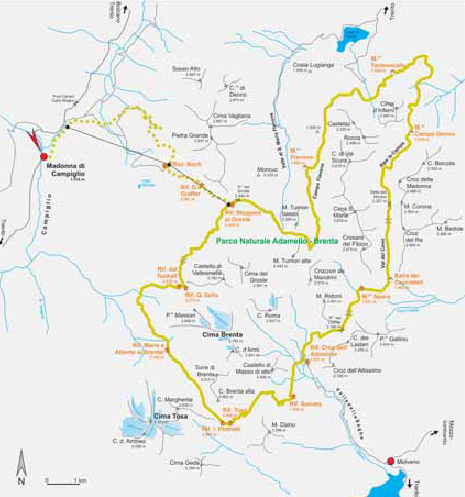
Click on map for larger image.


|
|

|
 |
|
Madonna di Campiglio – Campo Carlo Magno (loc. Fortini) – Rif. Stoppani al Grostè – Rif. Tuckett – Rif. Alberto e Maria ai Brentei – Rif. Pedrotti/Rif. Tosa |
In almost all itineraries, the ascent to the Stoppani al Grostè hut is achieved by cableway. However, this tour is designed for those who value the importance of doing things slowly so as to profoundly appreciate the surrounding and for this reason walking has priority. Naturally, if you prefer, you can also start this tour by cableway (open from the beginning of July to mid September, from 8.30 to 12.30 and from 14.00 to 17.00), shortening the fi rst day by 3½ hours. From the Stoppani al Grostè hut (2,442 m) follow path 316 on the plateau and cross a vast boulder fi eld. The path takes you through meadows and gravel all the way to the Tuckett hut (2,272 m). From the hut, follow path 328 walking on grasslands till the path forks at 2,048 m, and you take path 318. Follow the steep cliff of Val Brenta, go through the short tunnel (Galleria Bogani) then walk up once more to the Maria e Alberto ai Brentei (2,182 m) hut. Leave the hut and follow the signs of the alternative Expert route and walk up Campanile Basso following path 318 to “Bocca di Brenta” (2,552 m). Here you reach the Pedrotti hut (2,491 m) after a short descent or, slightly below, the Tosa hut (2,439 m). |
|
|
|
Accommodation
Rif. Stoppani al Grostè (2,442 m): Tel. +39-0465-440115, e-mail: info@groste.it, www.groste.it, open from mid June to the end of September, private.
Rif. Tuckett (2,272 m): Tel. +39-0465-441226, e-mail: rifugiotuckett.campiglio@tin.it, open from mid/end of June to mid/end of September, SAT-CAI.
Rif. Maria e Alberto ai Brentei (2,182 m): Tel. +39-0465-441244, open from mid/end of June to mid/end of September, SAT-CAI.
Rif. Pedrotti (2,491 m): Tel. +39-0461-948115, e-mail: donini.fortunato@tin.it, open from mid/end of June to mid/end of September, SAT-CAI.
Rif. Tosa (2,439 m): same as Rif. Pedrotti.

Brenta’s gentle side and the vast Pian della Nana. Foto: APT Val di Non
|
|
|
|

|
 |
|
Rif. Pedrotti/Rif. Tosa – Rif. Selvata – Passo del Clamer – Malga Spora – Sella del Montoz – Malga Campo Denno |
From the Pedrotti hut (2,491 m/Tosa hut 2,439 m) descend to the Selvata hut (1,630 m) and continue till the Croz dell’Altissimo hut (1,431 m). Shortly before Croz dell’Altissimo, take path 44 to Pass del Clamer (2,164 m). Walk across beautiful meadows and after a short descending slope, you reach Malga Spora (1,851 m), which is run by the alpine club and here you can spend the night1. After Malga Cavedago (1,848 m) take path 338 in the beautiful Val dei Cavai and reach Sella del Montoz (2,327 m). After passing by Alpe la Campa you fi nally reach Malga Campo Denno (= Malga Campa; 1,978 m) beneath the rocky walls of Croz della Madonna or Cimon di Campa.
Nota:
1 If you stay overnight at Malga Spora you extend the trekking tour by one day, and you stay at Malga Flavona the next day (unwardened). |
|
|
|
Accommodation
Malga Spora (1,851 m): Tel. +39-0461-653637, periodo di apertura: da inizio luglio a fi ne agosto, SAT-CAI.
Malga Campo Denno (1,978 m): rifugio non gestito (sempre accessibile); materassi e coperte disponibili, privato.
|
|

|
To Rif. Stoppani al Grostè:

With descent to Madonna di Campiglio:

Malga Campo Denno – Malga Loverdina – Malga Termoncello – Malga Flavona – Rif. Stoppani al Grostè – Madonna di Campiglio |
From Malga Campo Denno (1,978 m) take the ascending path 370. The following descent heads north and crosses a zone of mugo pine trees all the way to Malga Loverdina (1,771 m). After another short descent, take a road leading you to the alpine grazing of Termoncello (1,856 m). After a few ups and downs and a stunning view of lake Lago di Tovel, take path 330 running along the magnifi cent highland of Campo Flavona, to reach Malga Flavona (1,858 m). Walk up and head south till you take path 301. Walking amongst boulders you cross the Sella del Turion (saddle), follow path 301 till Passo del Grostè (2,442 m) and you fi nally reach the Stoppani al Grosté hut (2,442 m). If you have enough time, you can end the tour by descending to Madonna di Campiglio on the same day. This will take an additional 2½ hours. If your legs are tired and you have not got enough time, you can descend to the valley by cableway, spend the night at the Stoppani al Grostè hut, or descend to the G. Graffer hut (2,261 m) and spend the night there. |
|
|
|
Accommodation
Malga Flavona (1,858 m): unwardened hut (always open); mattresses and blankets available.
Rif. Stoppani al Grostè (2,442 m): Tel. +39-0465-440115, e-mail: info@groste.it, www.groste.it, open from mid June to the end of September, private.
Rif. G. Graffer (2,261 m): Tel. +39-0465-441358, e-mail: rifugio@graffer.com, www.graffer.com, open from mid June to mid/end of September, SAT-CAI.
|
|

|
|
|
Read more about the resorts around the Brenta Dolomites tour |
|
|
|
|
|
|
Here is an excellent link on how to get there. Wherever you are going.
Michelin
|
|
|