|
In this section we present a chapter from the book
Per Alpes, Discovering the Alps in 20 circular walks.
Read the tour description below or download the book here.
|

the symbol of Slovenia |

Triglav crowns the Julian Alps. Foto: M. Lenarčič – www.panalp.net |
|

Triglav (2,864 m) may not be amongst the highest peaks in the Alps, nevertheless its fame extends well beyond Slovenian borders. The enchanting Triglav massif in the Julian Alps is one of the oldest national parks in the entire alpine area, since it was granted this status in 1961. Triglav National Park covers an area of 838 km². The Seven Lakes Valley is the most popular part of the Park. The most striking aspect of the park is its immense diversity. In this natural hideaway you can walk along crystal-clear streams and steep cliffs and discover a rich variety of fl ora and fauna. Man has also played an important role in shaping this landscape. Traditional mountain agriculture is still practised particularly in Velo Polje, literally meaning “Big Field”. During summertime, this mountain is traditionally used as cattle pastureland. Triglav is a shrine for Slovenians and they all dream to climb it at least once in a lifetime and be able to marvel, on a clear day, at the ravishing view of the Adriatic, the Dolomites and the Hohe Tauern. The fi rst ascent of Triglav was achieved in 1778. Today Triglav is no longer a solitary place; it is estimated that every year it hosts about 20,000 visitors. The massif is also known for the numerous myths and legends that surround it, such as magic gardens, female ghosts and the legend of Zlatorog, the chamois with golden horns.
|
|
|
|

The challenge of Triglav should not be underestimated. You need to be fi t, use careful footwork and have a head for heights. Rocky trails are fi tted with cables and metal rungs. Those who might still feel unsafe, should bring a via ferrata kit. During summertime, the high number of climbers increases the risk of stonefall and possibly of avalanches. It is therefore advisable to wear a helmet and also to bring crampons, as you might still fi nd steep snowfi elds in July.
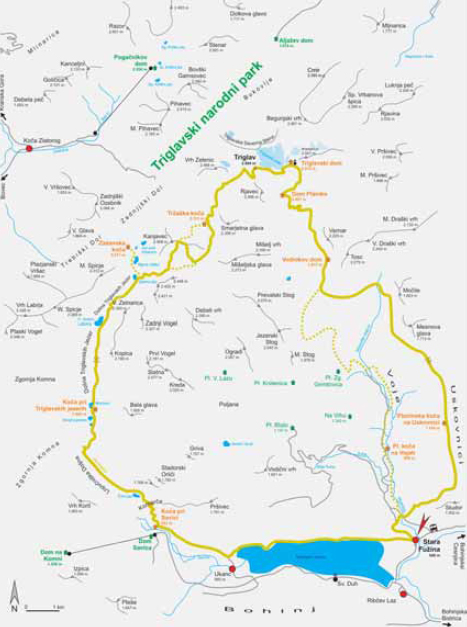
Click on map for larger image.


|
|

|
 |
|
Stara Fužina – Ukanc – Koča pri Savici – Koča pri Triglavskih jezerih |
Starting from Stara Fužina (546 m) the trail takes you along the northern bank of Bohinjsko Jezero (Lake Bohinj) and in approximately 1½ hours you get to the Ukancc(560 m). Initially follow a road, which later turns into a large path. Soon you reachcthe Koca pri Savici hut (653 m). At this point the real climbing begins! You gain 700cm climbing the Komarca crag. Beware of falling rocks! At 1,294 m, after a demandingcscramble, the path reaches the beginning of the Seven Lakes Valley (Dolina Triglavskihcjezer) and the fi rst lake (crno jezero). After crossing Lopucniska Dolina, a limestonecvalley, the trail continues uphill as far as the Koca pri Triglavskih jezerih (hut by the Seven Lakes; 1,685 m), which lies between Dvojno jezero (Lake Dvojno) and Mociveccjezero (Lake Mocivec). |
|
|
|
Accommodation
Residence Triglav (546 m): Tel. +386-(0)4-5729700, e-mail: info@residencetriglav.si www.residencetriglav.si, open all year, private.
Penzion Bohinj (546 m): Tel. +386-(0)4-5723481, e-mail: penzion-bohinj@stip.si www.penzion-bohinj.si, open all year, private.
Koca pri Savici (653 m): Tel. +386-(0)40-695787, open from the beginning of June to theend of September, PZS.
Koca pri Triglavskih jezerih (Hut by the Triglav Lakes, 1,685 m):Tel. +386-(0)40-620783, open from the beginning of July to the end of September, PZS.
|
|
|
|

|
 |
|
Koča pri Triglavskih jezerih – Kanjavec – Dolič – Tržaška koča na Doliču |
Today’s route will lead you all the way up to the fi rst summit, Kanjavec, but before this you need to cross the wild Seven Lakes Valley, a protected area since 1924 (it is forbidden to swim in the lakes). Passing by Veliko jezero (Big Lake), you are able to enjoy a great variety of landscapes and botanical species as well as a view of the towering Veliko Špičje (2,398 m). After reaching Zeleno jezero (Green Lake) the trail forks to the right, heading towards Hribarice saddle, then climbs steadily over a rocky gravel landscape all the way up to the summit of Kanjavec (2,569 m). From here, you can enjoy a dramatic view of the Triglav massif. There are two possible routes descending to Tržaška koča: one is a lower-off (with in situ gear), only recommended for experienced climbers; alternatively there is an easier route over the Hribarice saddle and the Dolič saddle. From this point it only takes a few minutes to the Tržaška koča na Doliču (Dolič hut, 2,151 m). |
|
|
|
Accommodation
Tržaška koča na Doliču (2,151 m): Tel. +386-(0)51-614780, open from the beginning of July to the end of September, PZS (after an avalanche in 2009, the hut was destroyed and then temporarily rebuilt).
Zasavska koča na Prehodavcih (2,071 m): Tel. +386-(0)51-614781, open from the beginning of July to the end of September, PZS.
|
|

|

Tržaška koča na Doliču – Triglavska škrbina – Triglav – Triglavski dom na Kredarici – Dom Planika |
Careful foot work and a head for heights are essential today. Initially the ascent from the Tržaška koča (Dolič hut) does not seem very demanding. However, soon after the the ruins of Caserma Morbegno (barracks) and Triglavska škrbina (Kugy Flitscher col, 2,659 m) you embark on a semi-equipped trail that leads up the rocky south-west ridge all the way up to Triglav’s summit (2,864 m). Here you can look for a quiet place and enjoy the breathtaking view. Afterwards you continue trekking along the east crest, which is also partially equipped, to reach the Triglavski dom na
Kredarici (2,515 m) hut. You could end your third trekking day at this stage, or, as recommended, follow the track as it curves around, heading south and then forks at 2,33 0m. Crossing Čez Štapce you lose 100 m and fi nally reach Dom Planika hut (2,401 m). |
|
|
|
Accommodation
Triglavski dom na Kredarici (2,515 m): Tel. +386-(0)4-5312864, open from the end of June to the beginning of September (the hut is also used as a weather station and it is always open. It is however advisable to phone in advance), PZS.
Dom Planika (2,401 m): Tel. +386-(0)51-614773, open from the beginning of July to the end of September, PZS.
|
|

|
 |
Dom Planika – Konjsko sedlo – Vodnikov dom – Čiprije – Koča na
Uskovnici – Stara Fužina |
The last day is not as demanding as the previous ones. However, a height loss of 1,300 m and the signifi cant length of the route are still rather challenging, especially when after three days of trekking legs start feeling the strain. From the Dom Planikav follow the direct path descending to Konjsko sedlo (2,020 m) and after a few ups and downs below the Vernar peak (2,225 m) the trail takes you to the Vodnikov dom (1,817 m). After a short ascent the track continues along the ridge, on the southwest flank of the Tosc (2,275 m) and follows the vegetation line instead of heading towards Studorski preval. At 1,600 m the trail descends into the woods, leading to Mount Uskovnica. For the last part of the journey, the track cuts through pastures to the Planinska koča na Uskovnici hut (1,154 m). Continue downhill towards the valley, first following a path, then, from Lom, it merges into a secondary road. Branch off on a path across the wooded northern slopes of the Studor (1,002 m), and after crossing the Preval saddle descend to the town of Stara Fužina. |
|
|
|
Accommodation
Vodnikov dom (1,817 m): Tel. +386-(0)51-607211 or +386-(0)4-5723213, open from theend of June till the end of September, PZS.
Planinska koča na Uskovnici (1,154 m): Tel. +386-(0)31-341821, open from mid June to the beginning of October, PZS.
|
|

|
|
|
|
|
Here is an excellent link on how to get there. Wherever you are going.
Michelin
|
|
|